Product tour
How fine-tuning works on Tensorant
Five screens from the console, on a sample project: review the data, train, evaluate, serve, and run every step as one experiment.
Watch the product demoThe five steps
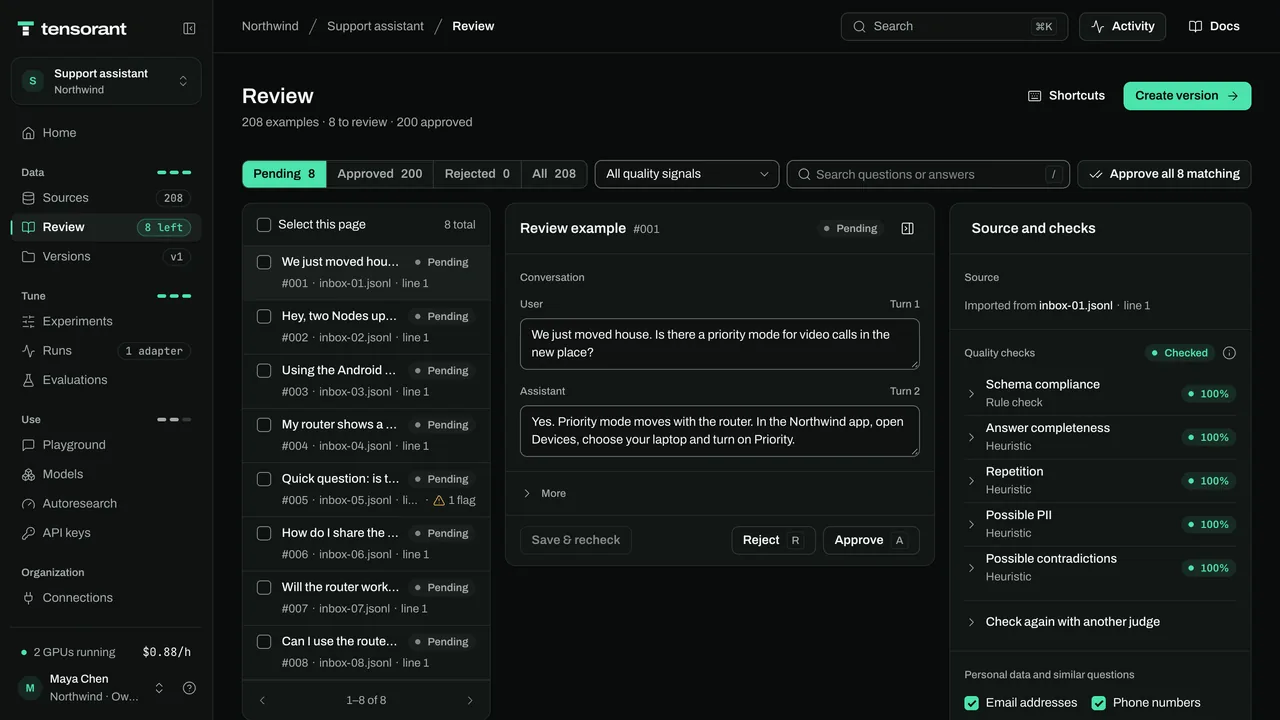
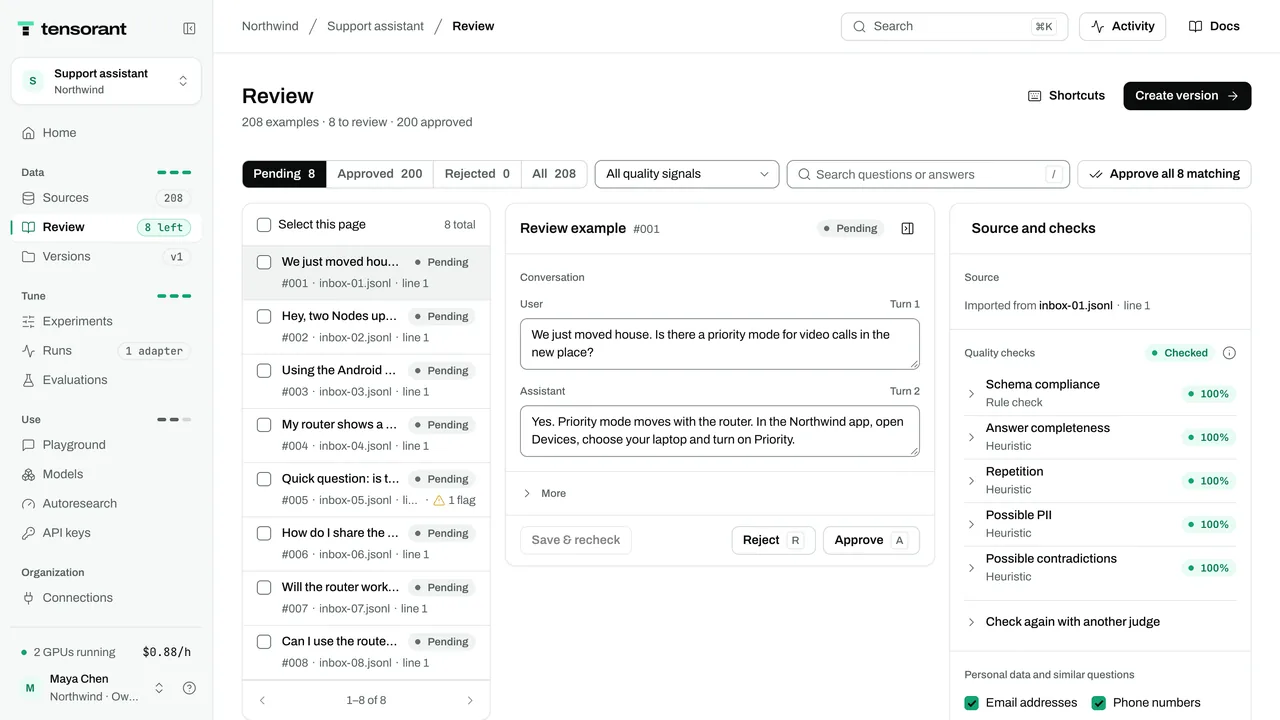
Review the data before you train on it.
Upload documents and spreadsheets, or import a Hugging Face dataset. Approve, edit or reject each example.
- Quality checks flag missing evidence, repetition and personal data.
- Starter recipes write examples from your documents, each quoting its source.
- Frozen versions keep training and test examples apart.
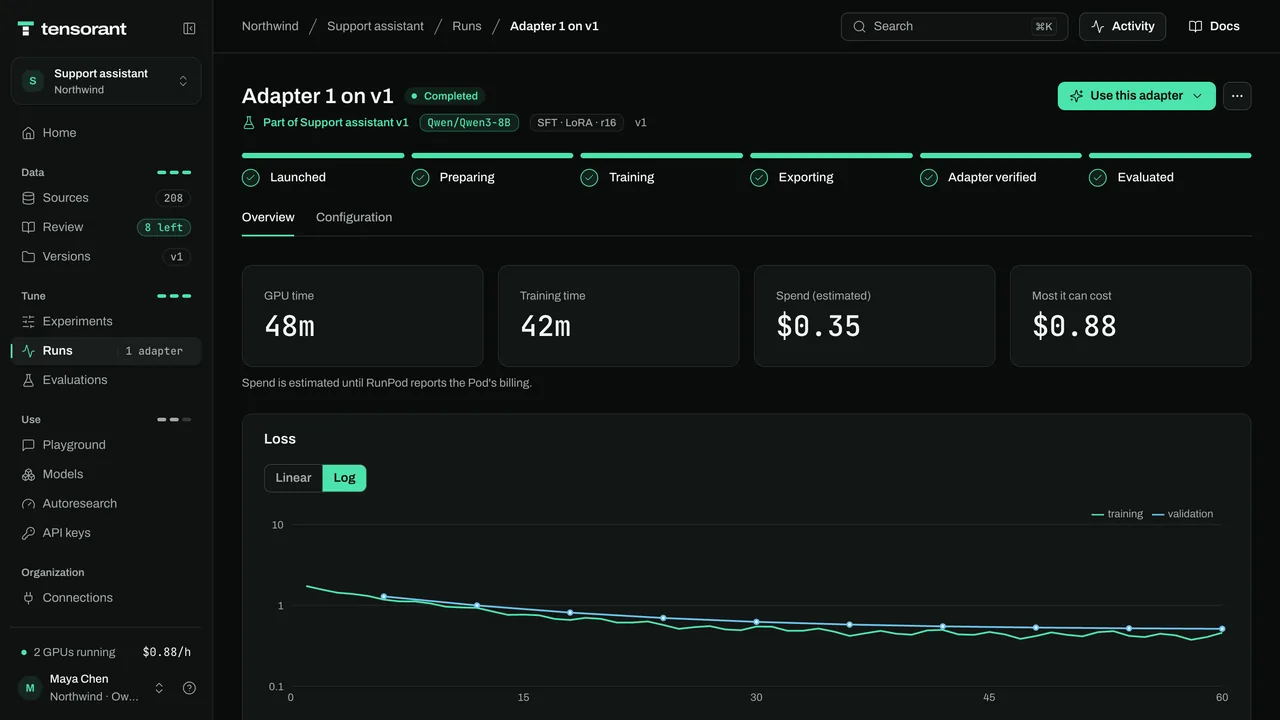
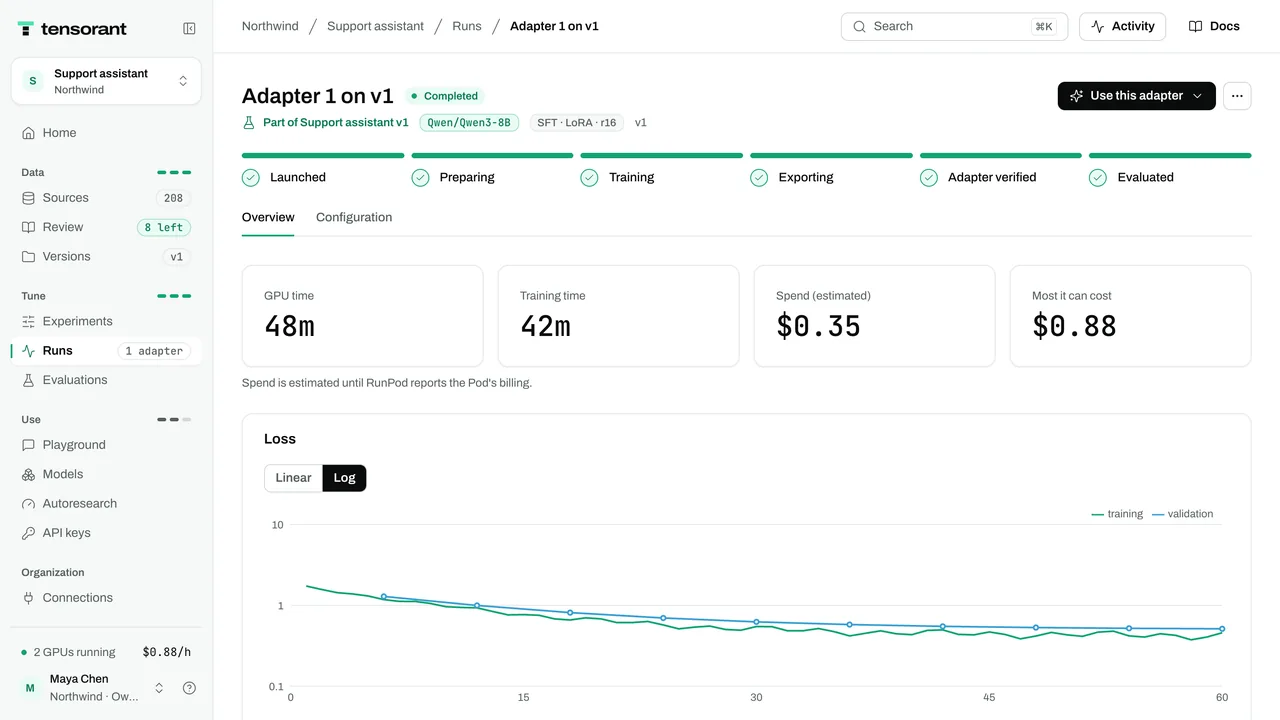
Fine-tune without writing a training script.
Pick a base model, a method (SFT, DPO or RL), LoRA or QLoRA, and 1 to 8 GPUs. RL trains with LoRA on one GPU. Tensorant checks the model fits before anything starts.
- Every run has a time limit and an hourly price cap.
- Follow the loss, the time and the cost while it trains.
- The GPU is released when the run ends or is cancelled.
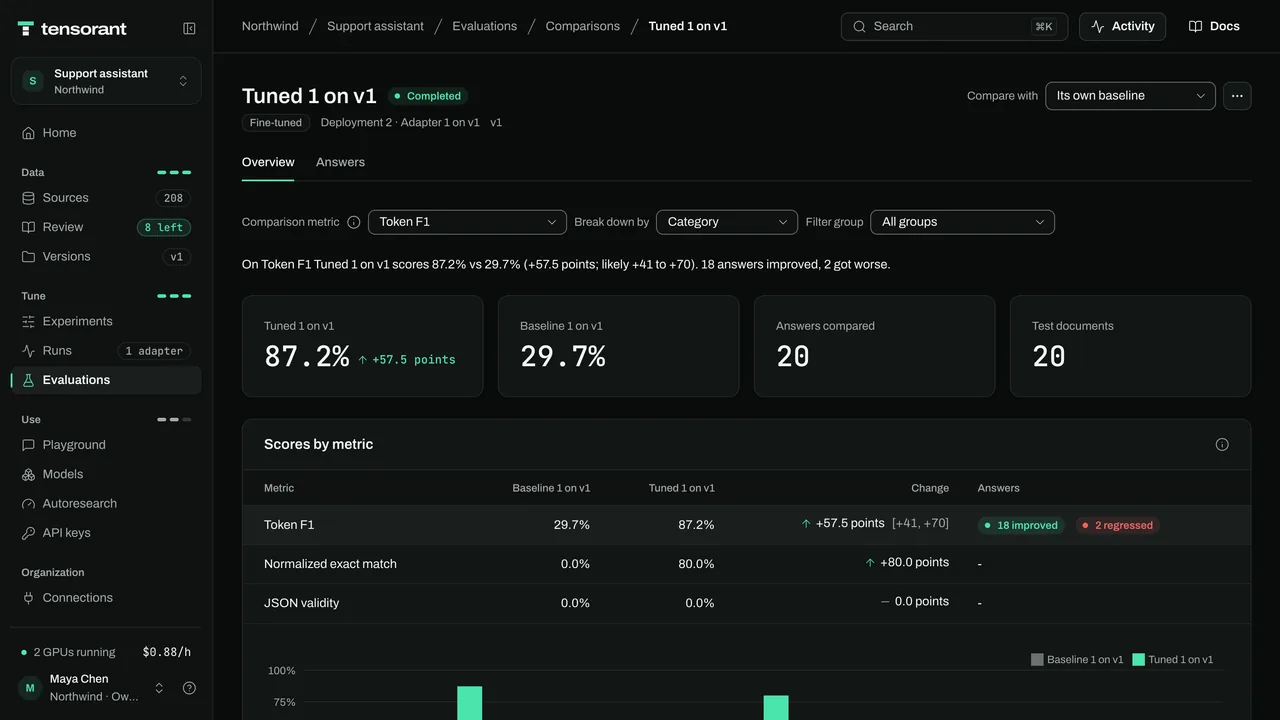
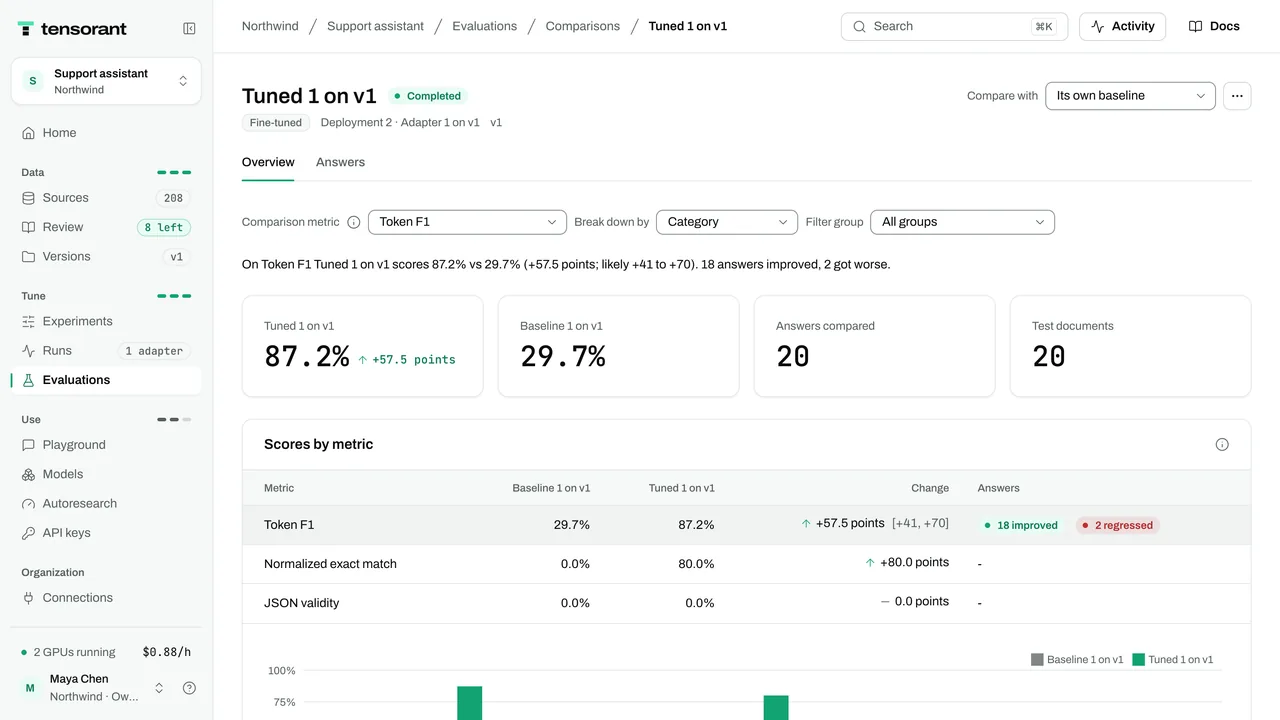
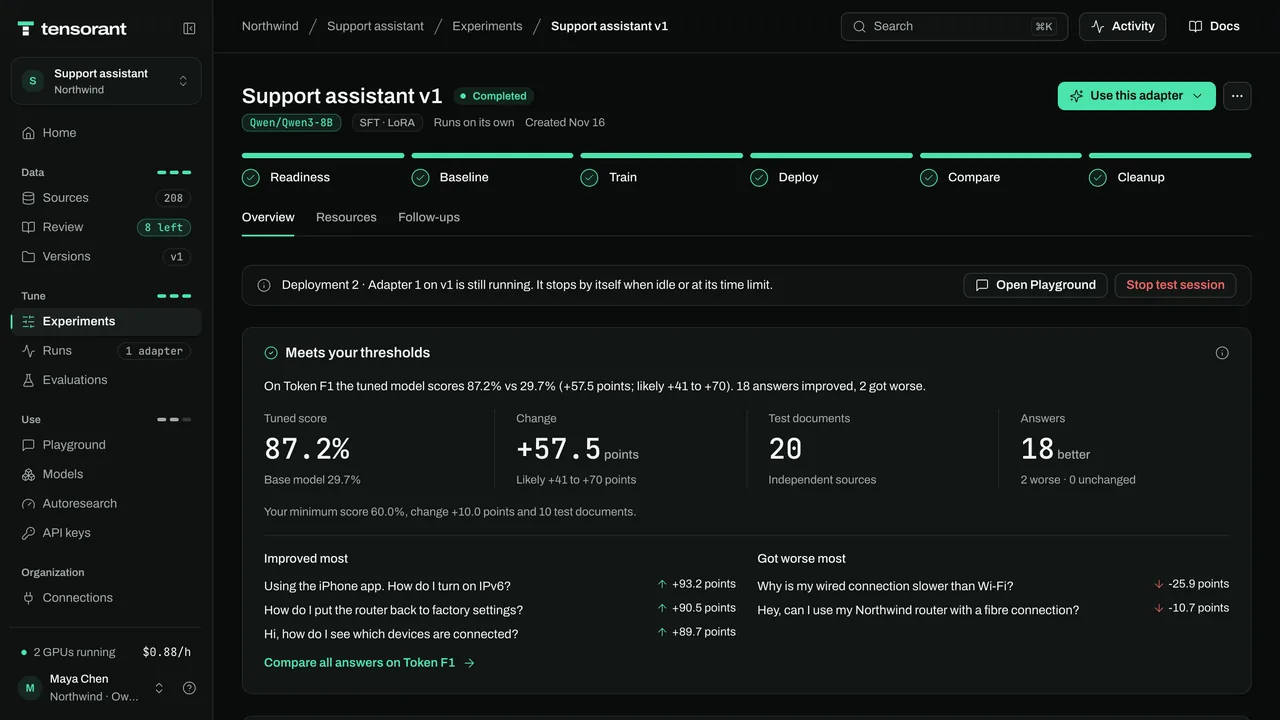
See whether fine-tuning helped.
The base and tuned models are scored on the same test examples with the same settings, answer by answer.
- Presets for Q&A, classification, JSON and numeric answers.
- An optional LLM judge scores answers against your rubric.
- See which answers got better and which got worse.
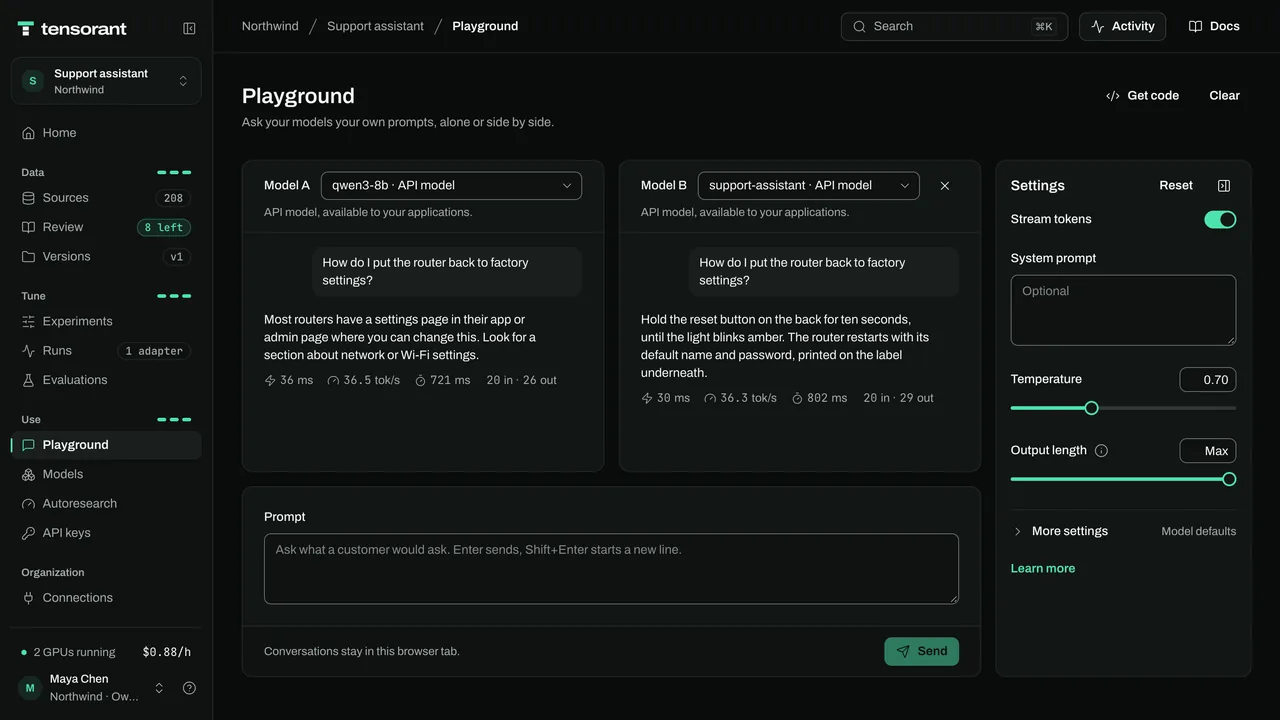
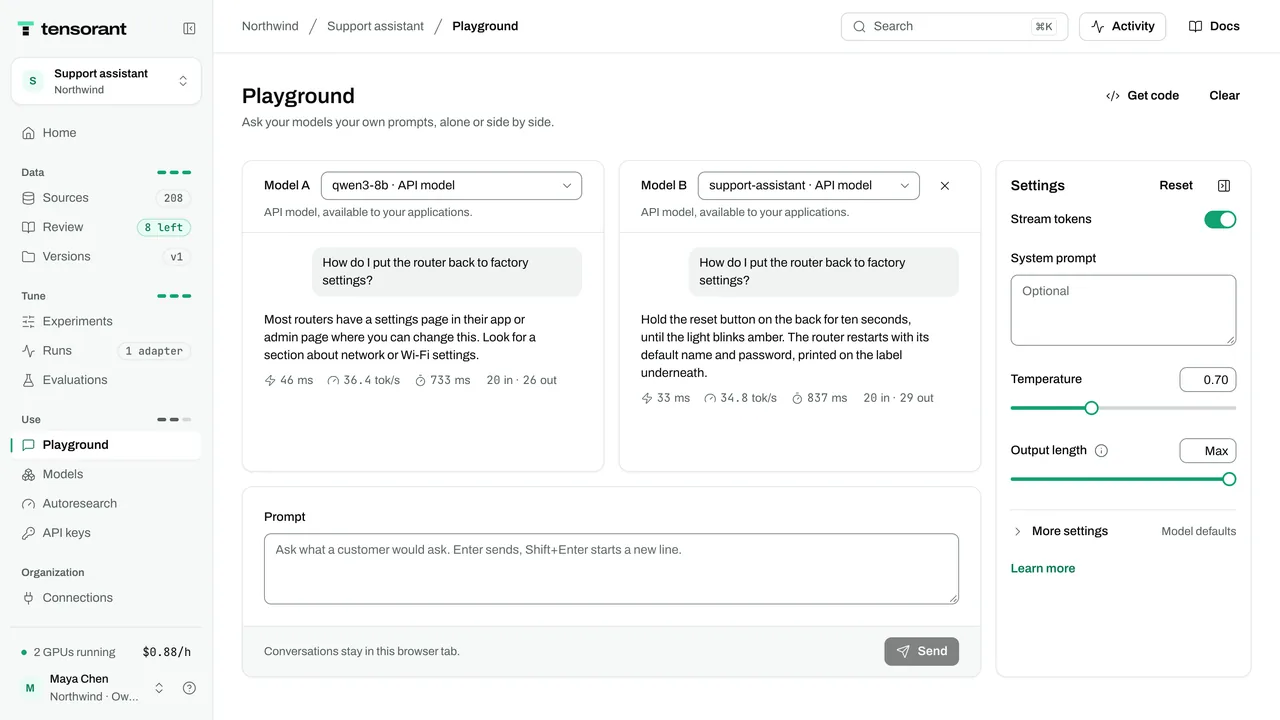
Deploy it behind an OpenAI-compatible API.
Publish the model under a name and call it with the OpenAI SDK. Keep it always on, or let it sleep and wake on the next request.
- Ask the base and tuned models the same question side by side.
- A sleeping model costs no GPU time.
- Keys per application, each with its own limits.
Run every step as one experiment.
Baseline, training, deployment, comparison and cleanup run in order once you approve the cost.
- Set the score the tuned model has to reach.
- See the score change and how certain it is.
- Test deployments stop on their own.
What it replaces
- chunk_pdfs.py
- review_examples.xlsx
- train.py
- eval_notebook.ipynb
- serve.sh
- # TODO: stop the GPU
Go deeper
Each stage has its own page
What a stage does, how it is set up and where its docs are.
Datasets
Turn raw documents into clean, reviewed train and test splits.
Fine-tuning
Train open models on your examples without writing training scripts.
Evaluations
Compare tuned and baseline models on held-out examples before deploy.
LLM inference
Serve open models behind an OpenAI-compatible API that costs $0 when idle.
Start with one dataset.
Create an account and import your data, or book a demo and we will show you the product.